"Just pressure wash it" is the most common answer people give themselves when a stucco wall looks streaked or dingy, and it is also the most common way a stucco wall gets damaged. Stucco, painted siding, and trim are not the same material as a concrete driveway, and treating them the same way is where the trouble starts.
Two different jobs, not one
Pressure washing and soft washing solve different problems, and mixing them up is the mistake.
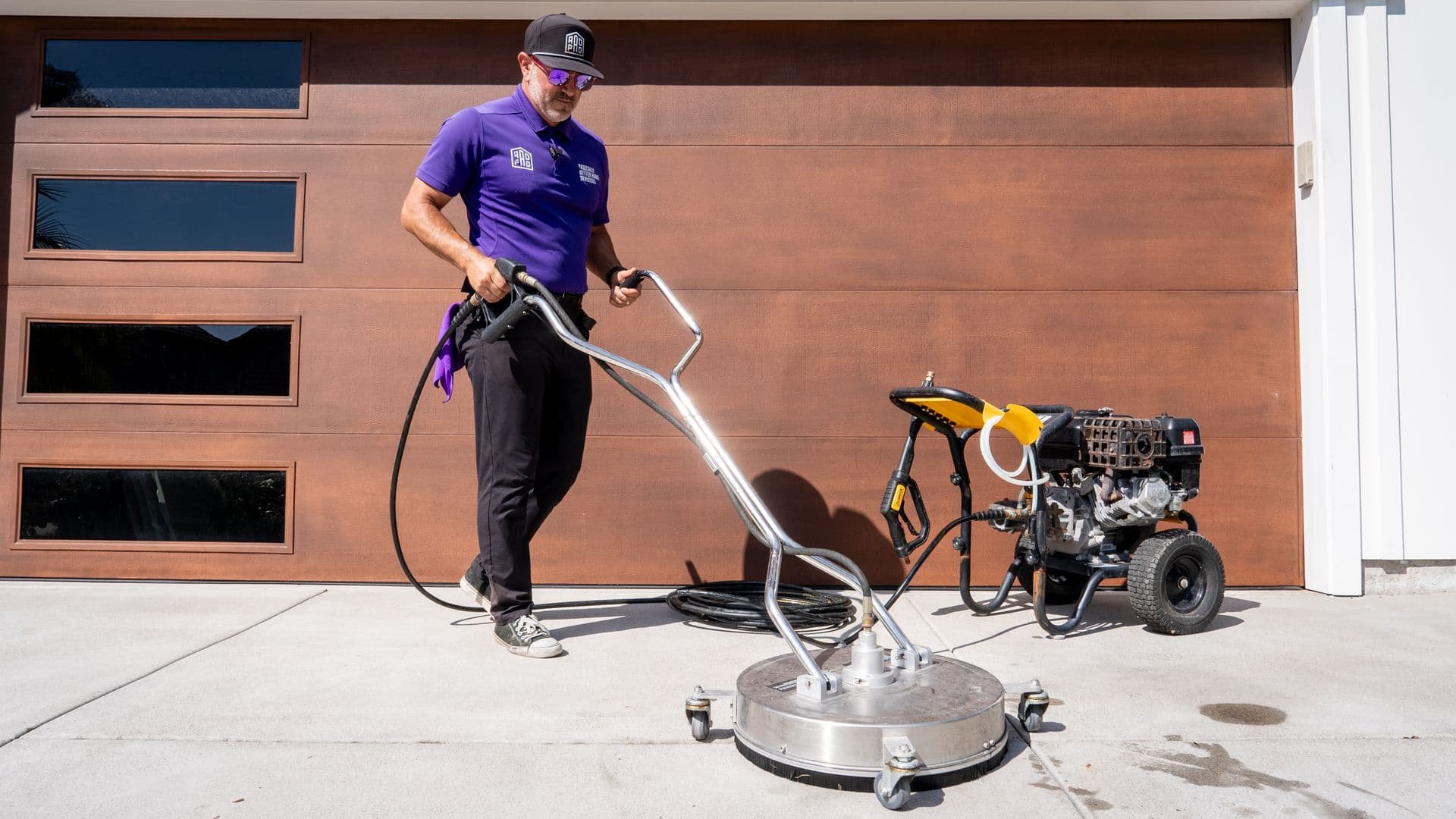
Pressure washing uses high water pressure, run through a rotary surface cleaner, to strip grime off hard, unsealed surfaces: concrete driveways, walkways, patios, and pool decks. The force is the point. Concrete can take it, and a rotary head spreads that force evenly so it does not leave wand stripes behind.
Soft washing uses low water pressure and a cleaning solution instead of force. The solution does the work of lifting algae, mold, and grime, and a gentle rinse carries it away. It is built for stucco, siding, and painted trim, surfaces that cannot take the same pressure a driveway can.
Putting a driveway-strength pressure washer against a stucco wall is where the two jobs get confused. High pressure on stucco, siding, or painted trim can force water behind the surface and strip paint and seals in the process. That risk is exactly why the method has to match the material: the rotary surface cleaner goes on concrete, and soft washing goes on the house.
What's actually causing the stains
The green and black streaks that send people reaching for a pressure washer in the first place are usually algae and mold, which is organic growth, not baked-on dirt. It collects wherever a surface stays damp: shaded walls, roof sections under trees, and north-facing stucco that the sun never quite dries out. Near the coast, the marine layer keeps homes damp for longer stretches of the day, which is part of why coastal stucco tends to need attention more often than stucco further inland.
That distinction matters because algae and mold are exactly what soft washing is designed to remove, cleanly, without the risk that comes with blasting it off a surface that was never built to take that kind of force.
Can you soft wash a roof too
Yes. Roof soft washing lifts the same algae and dark streaking from roofing without forcing water behind the shingles or tile, the same logic that applies to stucco and siding. A roof that has gone dark or streaky in patches, usually on the shaded side, is typically algae rather than a sign the roofing itself has failed.
How often this actually needs doing
There is no single number that fits every property. In general, RadPad's exterior services, including soft washing, run on an annual or bi-annual recurring schedule, and where a given home lands on that range comes down to how much shade it gets and how close it sits to the coast. A shaded, coastal property holds moisture longer and grows algae faster than an inland home in full sun, so it is reasonable for it to need a soft wash sooner than the once-a-year baseline. The honest answer for any specific house is to have someone look at it rather than guess from a general rule, since a wall with heavy shade and a wall with none are not on the same clock even on the same block.
DIY vs. calling someone
A rented pressure washer makes the pressure question worse, not better, because the whole point of soft washing is matching the pressure to the surface, and a rental unit is built to blast concrete, not to go gentle on painted trim. If the plan is to point a rented machine at stucco "on the low setting," that is the exact scenario that forces water behind the surface and strips paint, the same failure mode a professional soft wash is built to avoid.
Where DIY still makes sense: a garden hose and a soft brush on a small, easily reached spot of dirt, nothing more aggressive than that near stucco, siding, or trim. Anything beyond spot cleaning, a shaded wall gone green, a streaked roofline, or an entire elevation that needs attention, is a soft washing job, not a pressure washing one.
Soft washing across San Diego County
RadPad soft washes stucco, siding, painted trim, and roofs for homes throughout San Diego County and south Orange County, including Oceanside, Carlsbad, San Elijo Hills, Encinitas, Solana Beach, Del Mar, Rancho Santa Fe, Del Sur, La Jolla, San Clemente, and Dana Point. Coastal homes in this group see the marine layer firsthand and tend to need the service more often than homes further inland.
Soft washing is also commonly booked alongside concrete pressure washing for the driveway and walkways, so the whole exterior, hard surfaces and painted surfaces alike, gets handled correctly in one visit instead of two. It pairs just as easily with window cleaning or solar panel cleaning on the same schedule.
Full details on the service, including what a visit includes, are on the House & Roof Soft Washing page.
Written by
RadPad Home Service Pros
Locally owned exterior care across San Diego County and south Orange County: windows, solar, gutters, turf, surfaces and lighting, on one standard.
About RadPad