It depends on your roof. Whether a cleaning pays for itself comes down mostly to two numbers: how fast your panels collect dirt, and what each kilowatt-hour they produce is worth to you. In San Diego the second number is high, and the first varies a lot from one roof to the next.
Why the rain doesn't keep San Diego panels clean
Panels here have a timing problem. The San Diego County Water Authority puts average annual rainfall at roughly 10 inches on the coast, with much of it falling between December and March. That leaves most of the year for dirt to build up with little to rinse it, and as UC San Diego researchers point out, the long dry stretch lines up with the season of strongest sun.
The same UC San Diego study lists air pollution, sea salt, pollen, construction and agricultural dust among the usual sources. Near the coast, the marine layer keeps mornings damp. Panels cool overnight and collect dew, and researchers at the Department of Energy's National Renewable Energy Laboratory (NREL, now the National Laboratory of the Rockies) describe how that moisture can cement dust onto the glass until even a strong rain won't remove it.
NREL's operations and maintenance guide notes that heavy rain cleans panels almost completely, while light rain cleans far less and can even make soiling worse when dust sticks to scattered droplets. The same guide warns that uneven soiling, like bird droppings, can cause localized hot spots, and it cites losses as high as 0.5% a day where bird populations are large.
What the research measured
| Source | What it looked at | What it found |
|---|---|---|
| NREL | Energy lost to soiling each year | As much as 7% in parts of the United States |
| NREL soiling map, 83 U.S. sites | Where soiling hits hardest | Southern California, including San Diego County, had the greatest losses, from particulate pollution and long dry periods |
| UC San Diego, 186 California systems, 2010 data | Average loss between rains | 0.051% per day, or a 7.4% loss in efficiency by the end of an average 145-day dry spell |
| Same UC San Diego study | One wash halfway through the dry season | 0.81% more energy for the year on average, and up to 4% at some sites |
| NREL maintenance guide, simulated system in Mesa, Arizona | Yearly soiling loss by number of cleanings | 1.91% with none, 1.52% with one, 1.32% with two, 1.20% with three |
Taken together, the studies say soiling usually costs a few percent of a system's yearly output, up to 7% in parts of the country, and in both the UC San Diego data and the Mesa simulation, a single cleaning added less than 1% to yearly output on average. The UC San Diego authors concluded that soiling across California was relatively small and rarely justified the cost of cleaning, while sites near air pollution or dust storms may soil more heavily.
The spread matters more than the average, though. About a quarter of their sites lost more than 0.1% a day, roughly double the average, and nearly flat arrays (tilted under 5 degrees) soiled five times faster than the rest. The 35 systems in SDG&E territory averaged 0.027% a day, the lowest of the four regions studied, though the regional differences weren't statistically significant. The study also treated any rain over a tenth of an inch as a full reset, which dew-cemented dust can defeat. An average describes no one's roof in particular.
When cleaning pays off, and when it may not
NREL's guide lists the main factors: what the cleaning costs, how fast dirt builds up, how much sun the site gets, and what the power is worth, which is where San Diego stands out. SDG&E's average residential rate was $0.455 per kilowatt-hour in June 2026, excluding the California Climate Credit, according to the CPUC's Public Advocates Office. The national residential average was 18.31 cents per kilowatt-hour in July 2026, per the U.S. Energy Information Administration. A recovered kilowatt-hour is worth more here than in most of the country.
How much more depends on your rate plan. Under California's older net metering tariffs, exported power is credited at retail rates. Homes that applied for grid interconnection on or after April 15, 2023 are on the Net Billing Tariff, which credits exports at a rate reflecting their value to the grid, according to the CPUC. On either plan, power you use at home offsets electricity you would otherwise buy.
Cleaning is most likely to pay off with:
- Nearly flat arrays, which soiled five times faster in the UC San Diego data
- Trees overhead, adding pollen, leaves and birds
- Active construction, a busy road or industry nearby
- Birds roosting on or under the panels
- A coastal spot where the marine layer settles heavily
- Clear-day output that has slid since the last soaking rain
If your output holds steady through the dry season, there's little to win back yet, and waiting is the honest call.
How to check your own system for drift
Your monitoring app already holds the data NREL scientists use to spot soiling: daily production. Here's how to read it:
- Use clear days only. Clouds change daily output far more than dust does.
- Compare like with like. Line up a few cloudless days now against the same weeks last year, or against the first clear days after the last soaking rain.
- Look for the shape. Soiling shows up as a slow, steady slide through the dry months and a jump back after a real storm. At one site in the UC San Diego data, efficiency fell steadily after the last spring rain, and the fall rains restored it to where the year began.
- Check individual panels if your app shows them. One panel lagging points to a dropping, new shade or a hardware fault. The whole array sliding together points to dust and film.
- Rule out the other suspects. A growing tree, an inverter error or shorter fall days can all look like dirt.
If clear-day output has slipped a few percent below where it sat after the last good rain, and nothing else explains it, that gap is roughly what a cleaning would recover until the dust builds back up. For what to look for on the roof itself, see signs your solar panels need cleaning.
What safe cleaning involves
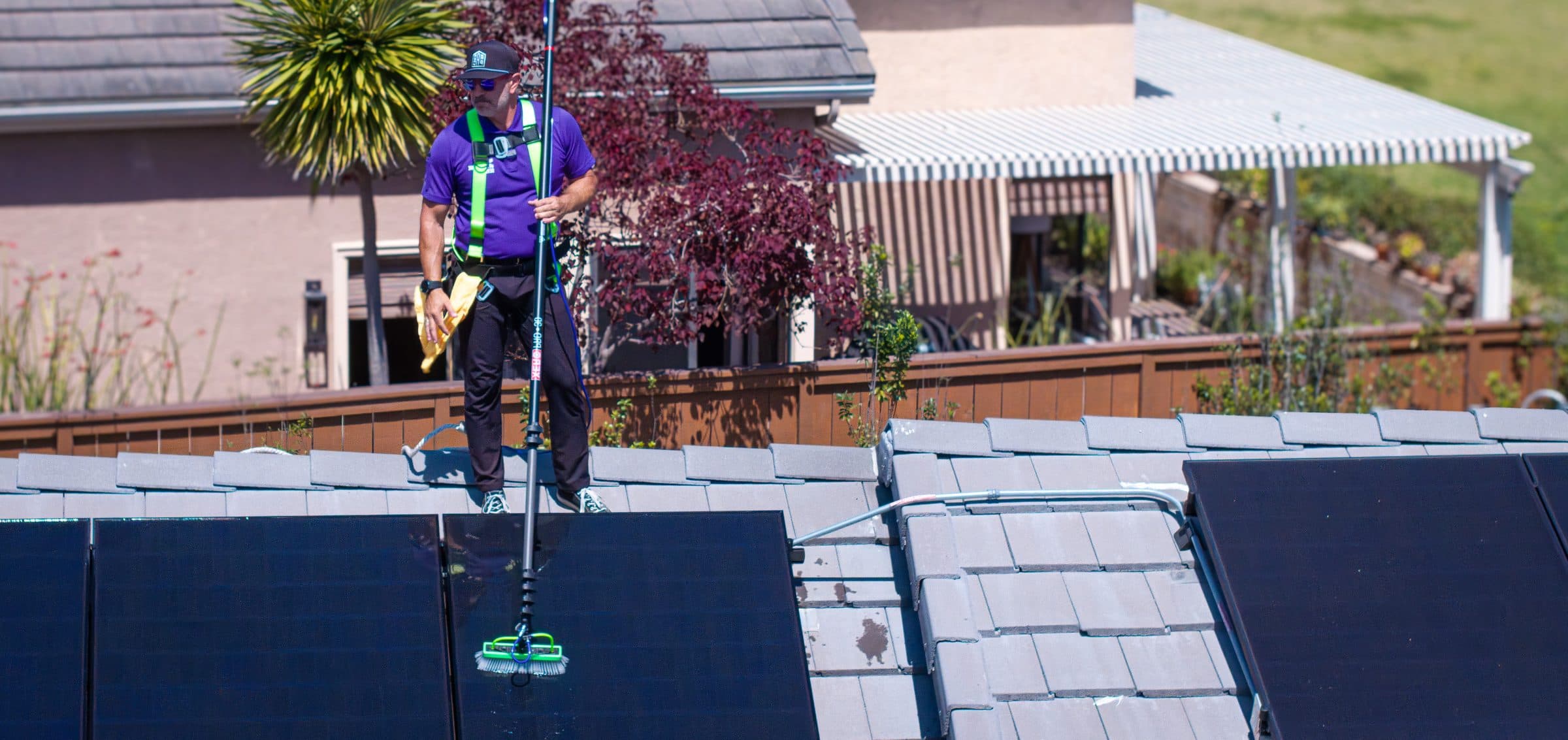
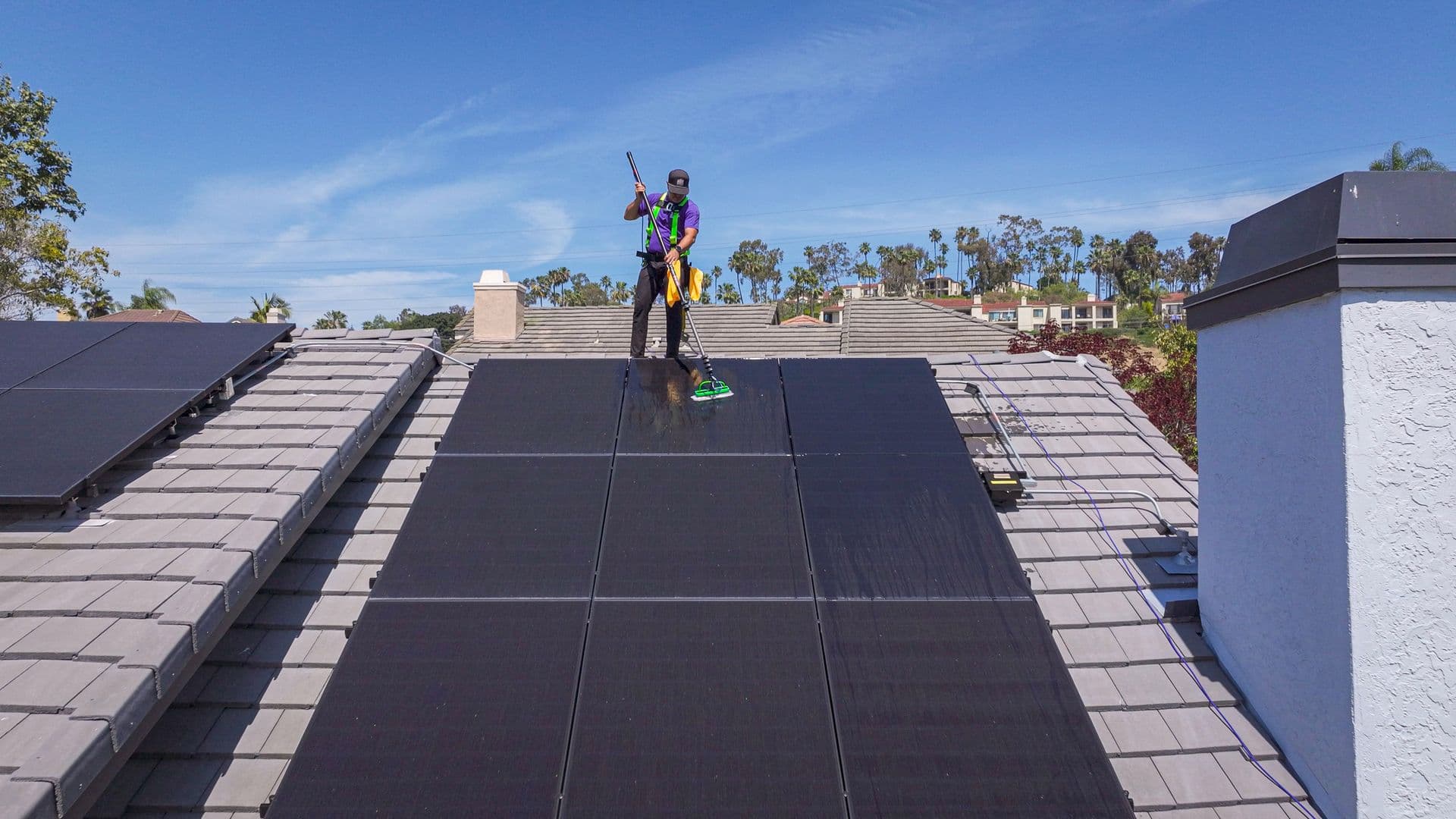
How panels get cleaned matters as much as whether they do. RadPad Home Service Pros cleans with deionized water and soft tooling, no detergents and no abrasives, which keeps the cleaning within what panel manufacturers allow, and NREL's guide likewise says to follow the module manufacturer's recommendations for any cleaning.
Water is the first reason. San Diego's tap water is hard: the City of San Diego's 2025 water quality report puts average hardness at its three treatment plants at 237 to 243 parts per million, mostly calcium and magnesium, and those minerals dry on the glass as spots. Deionized water dries without leaving mineral residue.
Pressure is the second: pressure washing a panel array is what puts a manufacturer's warranty at risk.
A visit is also a chance to look the array over, and RadPad's solar panel inspection and cleaning does both. If birds are the source of the mess, NREL's guide recommends dealing with them directly, for example by sealing the gaps under the array, and RadPad offers Critter Guards and Bird Proofing as add-ons.
How often to clean
RadPad's guidance is once or twice a year for most roofs, and more often under trees, near active construction, or where the marine layer settles heavily. On timing, the UC San Diego estimate assumed one wash halfway through the dry season, and NREL's guide suggests scheduling after pollen season ends or after nearby construction wraps up. A cleaning just before the rainy season usually buys the least, since a soaking storm does much of that work for free.
Where RadPad cleans solar panels
RadPad cleans residential and commercial solar arrays across Oceanside, Carlsbad, San Elijo Hills, Encinitas, Solana Beach, Del Mar, Rancho Santa Fe, Del Sur, La Jolla, San Clemente and Dana Point, and is rated 5.0 across 86 Google reviews. If your numbers show the dry-season slide, request a quote, or see how the solar service works first.
Written by
RadPad Home Service Pros
Locally owned exterior care across San Diego County and south Orange County: windows, solar, gutters, turf, surfaces and lighting, on one standard.
About RadPad