Most of the year, San Diego roofs go without a real rinse. The coast averages roughly 10 inches of rain a year, and much of it falls between December and March, according to the San Diego County Water Authority. In between, dust, pollen, and marine film settle on solar panels and mostly stay put.
That matters more here than in most of the country. When researchers at the Department of Energy's National Renewable Energy Laboratory mapped soiling data from 83 U.S. sites, they found Southern California counties experiencing the greatest losses "because of the high particulate matter concentrations and the long dry periods." The same paper says soiling causes "drops in the annual energy yield of up to 7% in the United States."
That's the top of the range, not what every roof loses. The best evidence for yours is your own system's numbers.
Start with your production numbers, not your bill
Your bill moves with utility rates and household use, so it's a poor gauge of the panels. The monitoring app shows what the array actually produced, and that's where soiling shows up first.
Compare fairly. October usually looks worse than July because the days are shorter and the sun sits lower, so put this month next to the same month last year. Weather matters too: a stretch of May Gray or June Gloom can pull a month down with no help from dirt. The cleanest test is a few clear days this month against clear days from the same weeks last year.
Rain also gives you a free experiment. If output jumps noticeably on the first clear day after a storm, the dirt the rain washed off was costing you.
Then read the pattern:
| What the app shows | Most likely cause | Next step |
|---|---|---|
| A slow slide over weeks of clear weather, no alerts | Soiling | Check the panels from the ground |
| A sudden drop, or no output at all | An equipment or system fault | Call your installer |
| A dip at the same time every day | New shade from a tree or a structure | Look for new growth or construction nearby |
| A low month that was also a cloudy month | Weather | Compare clear days instead |
Then look at the panels from the ground
You don't need a ladder. Binoculars or a zoomed-in phone camera, from the yard, the street, or an upstairs window, will show most of what matters:
- A dull, hazy film where the glass should look dark and glossy
- A band of dirt along the lower edge of each panel, where dew and rinse water run down, pool against the frame, and dry
- Bird droppings, pollen, leaves, or sap sitting on the glass
- Spots or streaks where sprinklers or light rain dried on the glass
If you can see dirt, that alone is a reasonable trigger. Panel maker REC's cleaning guide recommends cleaning "when dirt can be seen on the glass surface."
Bird droppings deserve extra attention, because a dropping blocks most of the light over one small spot. A best-practices guide from NREL, Sandia National Laboratories, and industry partners warns that uneven soiling "can lead to localized hot-spot failures" and points to bird droppings as an example. Birds roosting on or nesting under the array are a job for critter guards or bird proofing, not just cleaning.
Know whether your roof gets dirty faster
Once or twice a year is enough for most roofs. Plan on more often if yours has:
- A tree nearby. Leaves, pollen, and sap land on the glass, and branches give birds a place to perch.
- Construction nearby. A new build or remodel down the street keeps fine dust in the air for as long as the work lasts.
- Salt exposure. Closer to the coast, salt spray and a heavy marine layer leave a film that dries hazy on the glass.
What not to do yourself
If you can reach your panels safely from the ground, cleaning them yourself is a reasonable choice. These are the mistakes to avoid:
- Climbing onto the roof. Among workers, approximately 20% of fall injuries involve ladders, according to the CDC. And never step on a panel: REC's guide warns that standing, walking, or leaning on panels can cause damage, including damage you can't see.
- Pressure washers. REC's guide says "pressure or steam cleaners and high pressure hoses" are "not permitted on REC panels and will invalidate the warranty."
- Hard tap water. Minerals in tap water stay behind as spots when it dries, the opposite of what you want on a surface whose whole job is letting light through.
- Abrasive brushes and scrapers. Canadian Solar's installation manual warns that dirt "must never be scraped or rubbed away when dry, as this will cause micro-scratches on the glass surface."
- Soap and household cleaners. Anything that has to be rinsed off can dry on the glass too, and some makers limit what can touch it: Canadian Solar allows only "substances explicitly approved by Canadian Solar."
- Cleaning hot panels. Cool water on hot glass can crack it, which is why REC says to clean in the early morning, before the panels warm up.
Before you start, find your panel brand on the installation paperwork and read the cleaning section of its manual, because the warranty can ride on it. Canadian Solar's manual is blunt: "Damages induced by inappropriate cleaning procedures will void Canadian Solar warranty."
When to call someone
- Your panels are on a second story or a steep roof, or the only way to reach them is to walk the roof.
- Output has slipped and you can see film or droppings you can't reach from the ground.
- You can see damage: cracked glass, a loose mount, or wiring hanging below the array. Don't clean a damaged panel. REC warns that damaged panels "can present a lethal shock hazard due to leakage currents," and the risk is higher when they're wet. Repairs are a job for your installer.
- Birds are nesting under the array.
What a proper cleaning includes
Whoever you hire, this is what to expect:
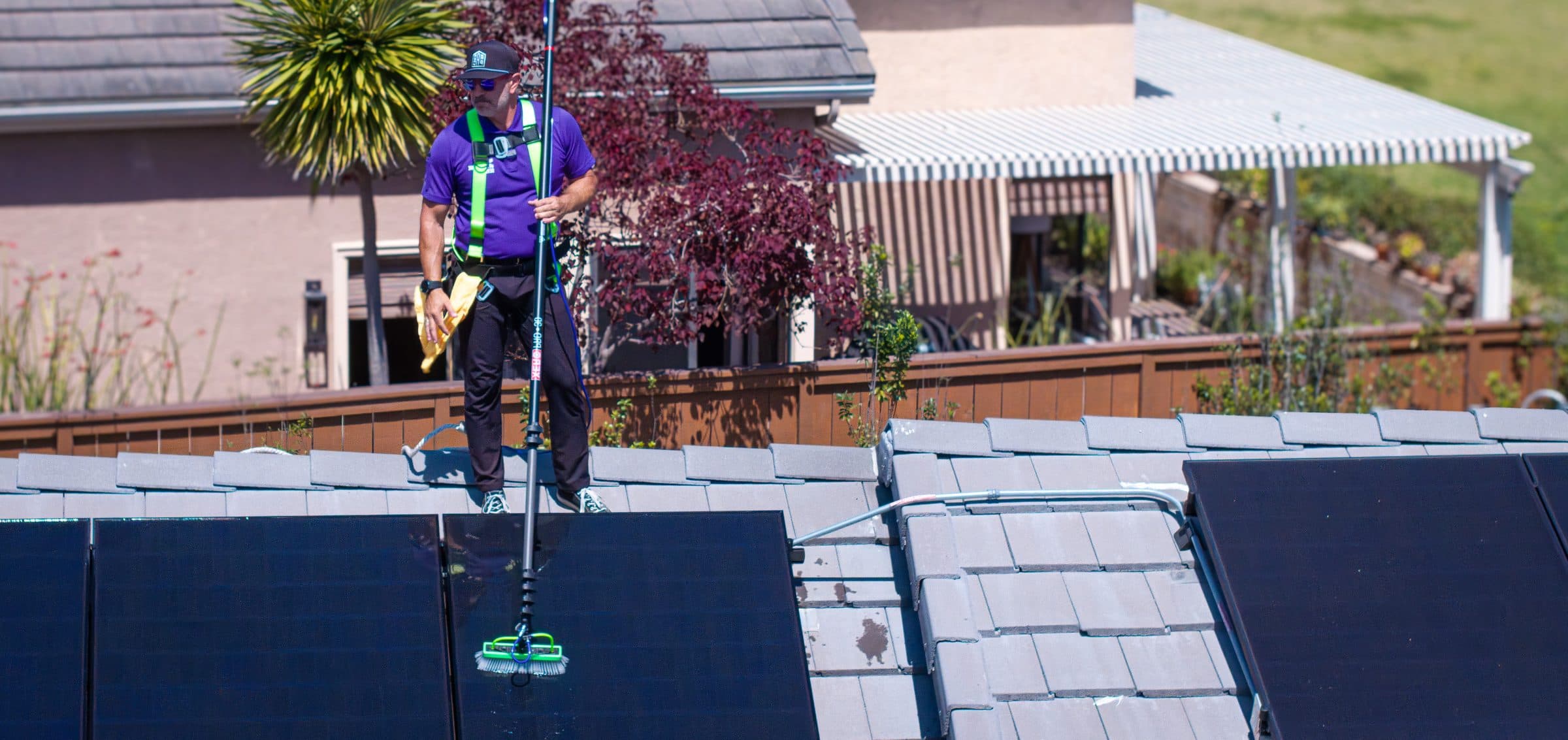
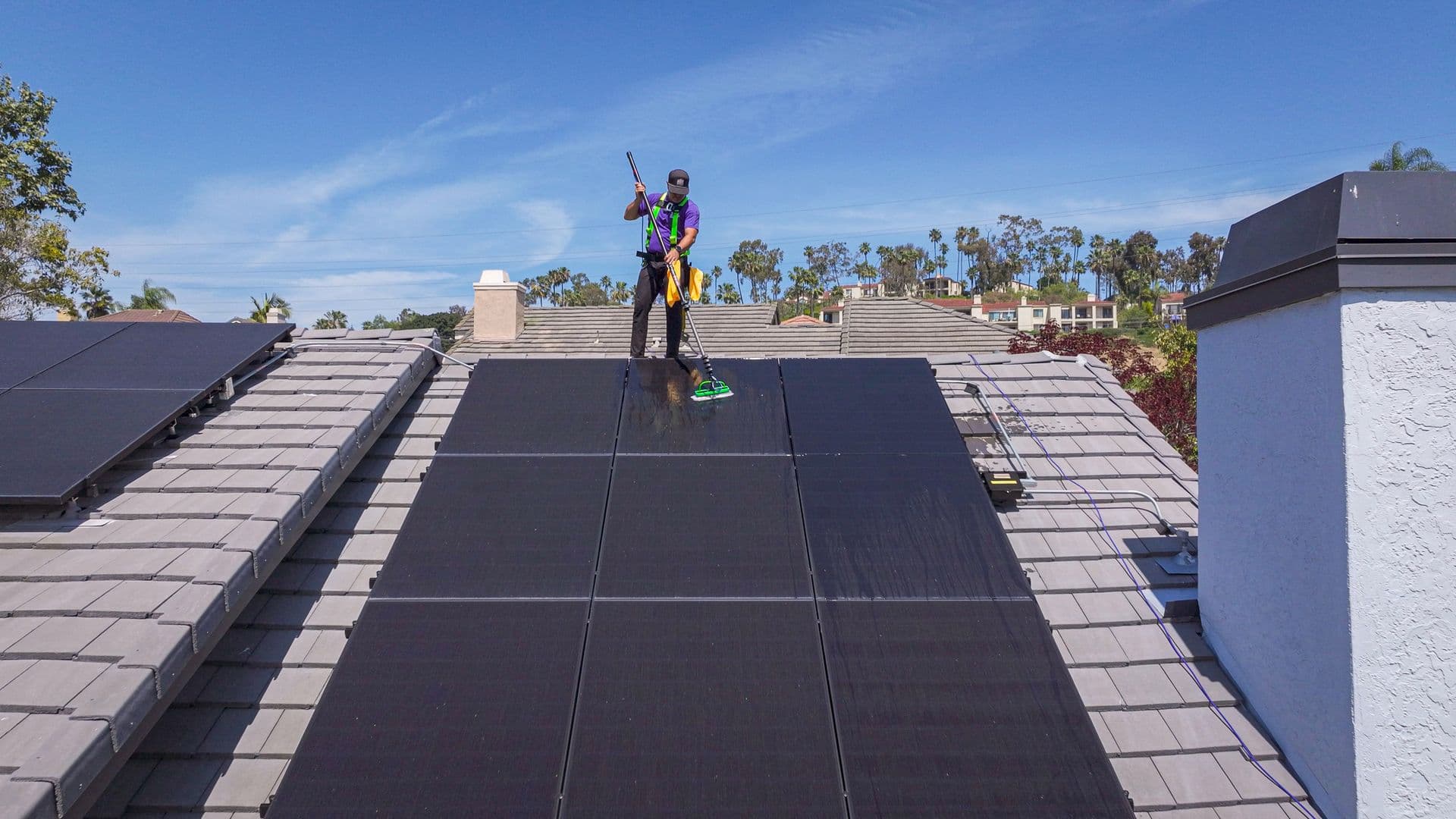
- Deionized water. It dries without leaving mineral residue, and it's the water REC's guide names as ideal for cleaning panels.
- Soft tooling, no detergents, and no abrasives. That keeps the cleaning inside what panel makers allow.
- No pressure washer. Pressure washing a panel array is what puts a warranty at risk.
- A visual check alongside the cleaning. Loose mounts, damaged panels, and wiring problems are easiest to catch while someone is up close, and anything found should be photographed and reported to you.
That's how RadPad Home Service Pros handles residential and commercial solar cleaning. Every cleaning includes a visual inspection, and if RadPad finds a problem, it photographs it and tells you, so you can take it to your installer. Critter Guards and Bird Proofing are available as add-ons where birds are the issue.
After any cleaning, check the app over the next few clear days. If production climbs back, soiling was the problem. If it doesn't, look at shade or equipment next. Whether regular cleaning pays for itself is its own question, covered in our post on whether solar panel cleaning is worth it in San Diego.
RadPad cleans solar panels in Oceanside, Carlsbad, San Elijo Hills, Encinitas, Solana Beach, Del Mar, Rancho Santa Fe, Del Sur, La Jolla, San Clemente, and Dana Point. If your numbers have slipped and you'd like someone to take a look, get in touch or read more about solar panel cleaning.
Written by
RadPad Home Service Pros
Locally owned exterior care across San Diego County and south Orange County: windows, solar, gutters, turf, surfaces and lighting, on one standard.
About RadPad