Coastal San Diego is easy weather to live in and steady work for a house. Salt air, the marine layer, long dry months, and a short, sharp rainy season each work on a different surface, on its own clock. None of it ruins an exterior in a single season. It does mean a maintenance schedule written for a wetter climate tends to miss here.
This guide covers each surface in turn: what wears it down, how often it needs attention, and the method that cleans it without damage. RadPad Home Service Pros handles every one of them across San Diego County and south Orange County, and each section links to the matching service.
What the coast does to a house
Four conditions do most of the work on a coastal exterior:
- Salt air. Near the water, it films up glass within weeks, dulls anything with a metal finish, and settles on solar panels, where it cuts output quietly rather than obviously.
- The marine layer. It can persist for days or weeks, and its persistence in early summer is why people in Southern California often call it May Gray and June Gloom, according to NOAA. It helps keep coastal glass filmed over, and the damp it leaves on shaded walls and paving gives algae and mildew a start.
- Long dry stretches. The San Diego coast averages roughly 10 inches of rain a year, and much of it falls between December and March, according to the San Diego County Water Authority. The rest of the year, dust, pollen, and leaf litter build up with little to rinse them away.
- Hard water. Sprinkler overspray and tap-water rinses leave white spots as they dry on glass and panels. That's mineral residue: hard water is high in dissolved minerals, largely calcium and magnesium, according to the U.S. Geological Survey.
Windows and glass
What wears it down: Salt spray and marine film near the coast, plus hard-water spots from irrigation overspray that ordinary cleaning won't shift. Large panes show all of it.
How often: Twice a year for most homes, since dust, pollen, and overspray build up steadily instead of washing off with rain. Within a mile or two of the coast, a quarterly schedule often looks better.
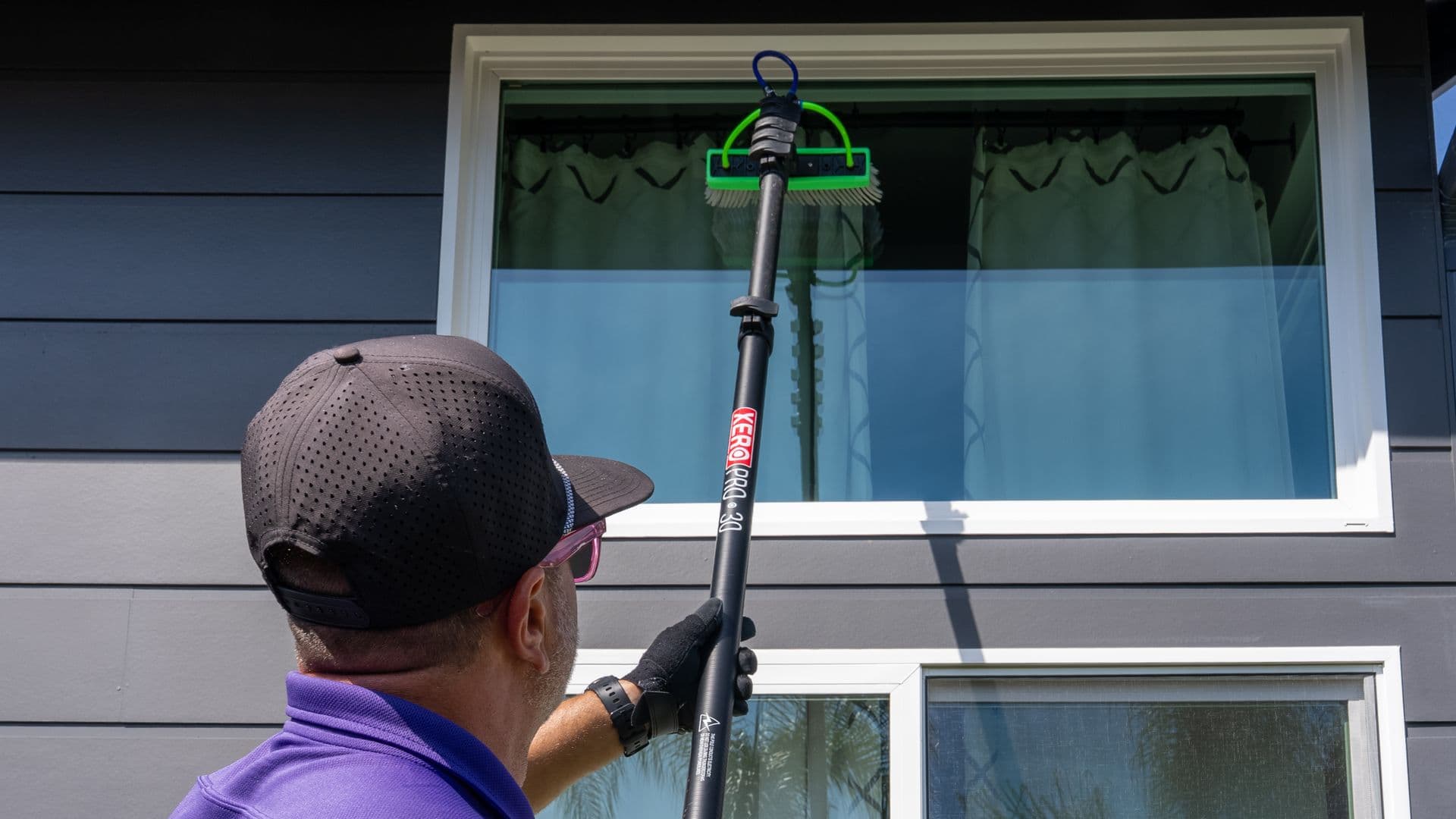
The method: Purified water on the exterior pass, so there's nothing dissolved in it to dry on the glass. Tracks, sills, and screens are cleaned in the same visit, because clean glass in a gritty frame still looks half done. Upper-story glass is reached with extension poles rather than ladders leaned against the building, which spares the gutters and siding and is safer for the technician: among workers, approximately 20% of fall injuries involve ladders, according to the CDC.
See Window Cleaning & Glass Care for the full scope, and what to look for in a window cleaner for why glass spots so soon after a tap-water wash.
Solar panels
What wears it down: Dust, pollen, salt, and marine film all cut the light reaching the cells, and the loss builds slowly enough to be easy to miss. The energy lost annually from soiling amounts to as much as 7% in parts of the United States, according to research from the Department of Energy's National Renewable Energy Laboratory, now the National Laboratory of the Rockies.
How often: Once or twice a year for most roofs, and more often under trees, near active construction, or where the marine layer settles heavily.
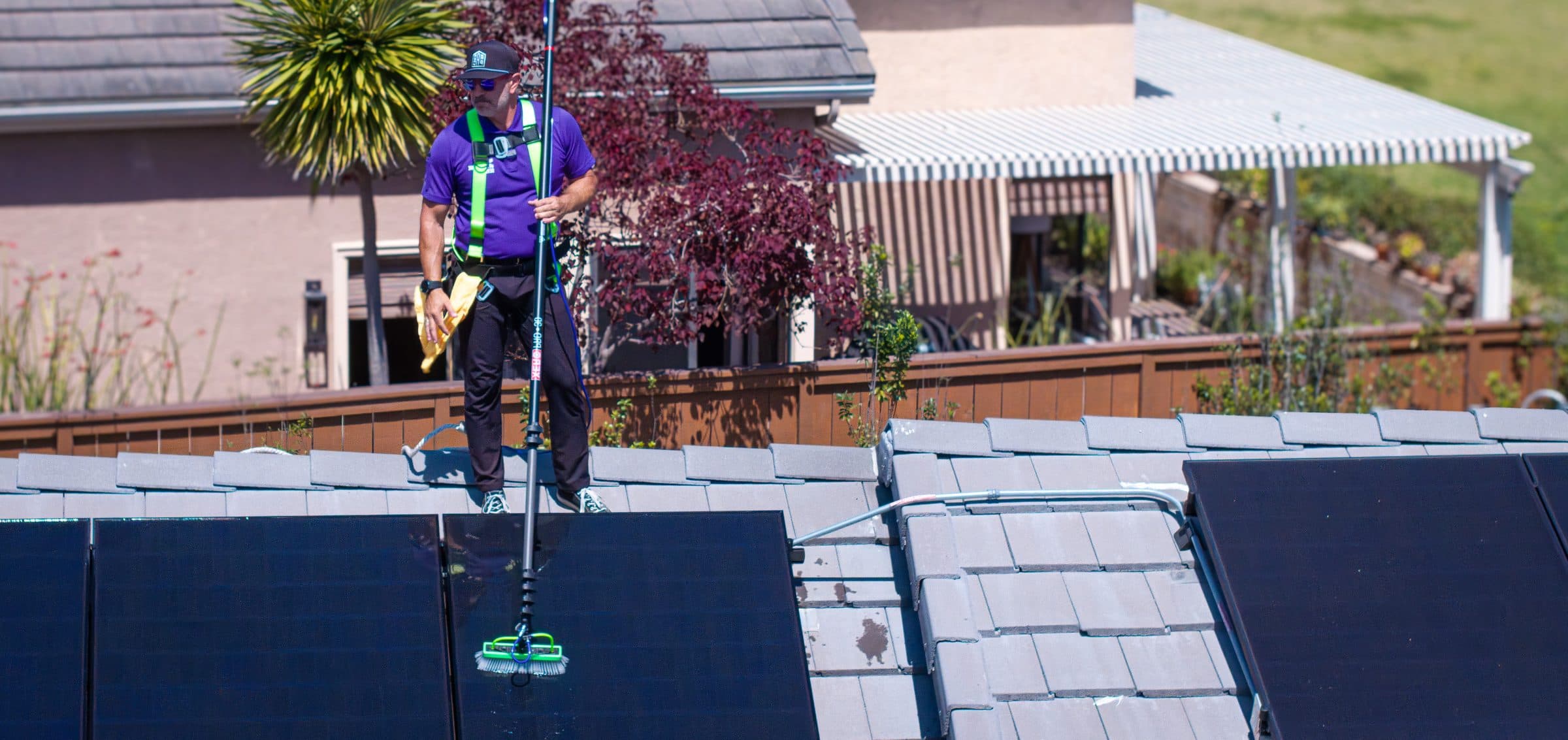
The method: Deionized water, which dries without leaving mineral residue, and soft tooling that won't scratch the glass. No pressure washer goes near the array.
See Solar Panel Cleaning & Protection, and for more depth, whether solar panel cleaning is worth it in San Diego and the signs your panels need cleaning.
Gutters and downspouts
What wears it down: Gutters fill quietly through the dry months with palm fronds, eucalyptus leaves, pine needles, and windblown dust, then take the first real storm all at once. A clogged run doesn't drain slowly. It overflows beside the fascia, siding, and foundation, and water is no small risk: water damage and freezing accounted for 22.6% of homeowners insurance losses in 2023, according to the Insurance Information Institute. Dry debris is a fire concern too: CAL FIRE says debris that collects in uncovered gutters is highly susceptible to embers and fire, and advises cleaning gutters regularly.
How often: Before the rainy season and again after it, and if only once, before the first rain. Lots under eucalyptus and pine often need more.
The method: Troughs cleared by hand, downspouts flushed and flow confirmed before the crew leaves, and debris bagged and hauled away rather than left on the lawn. A clean trough feeding a blocked downspout still overflows, so the flush matters as much as the scoop. Problems like loose fasteners or separating seams are photographed and reported.
More on timing in when to clean your gutters in San Diego, and on the service itself at Gutter Cleaning & Maintenance.
Stucco, siding, and painted trim
What wears it down: Salt film and dust dull the finish, and shaded walls that stay damp under the marine layer pick up algae and mildew streaks. On older coastal homes, painted timber and weathered trim don't respond well to pressure at all.
How often: Like most of RadPad's services, soft washing is usually scheduled once or twice a year, depending on the property.
The method: Low-pressure soft washing, with a cleaning solution that lifts algae and grime. Too much pressure can damage stucco, siding, and other painted or textured surfaces, forcing water behind them or stripping paint and seals. Tile roofs can crack under a pressure wand, so they get roof soft washing instead. Both are part of Surface Cleaning & Sealing.
Concrete, pavers, and hardscape
What wears it down: Driveways, walkways, patios, and pool decks collect dust and organic staining, and under mature trees they pick up resin and leaf debris too. Shaded paving grows algae the same way shaded walls do.
How often: Usually once or twice a year, like most exterior work, and on a steady schedule in HOA communities, where a frontage is easier to keep up than to recover after a lapse.
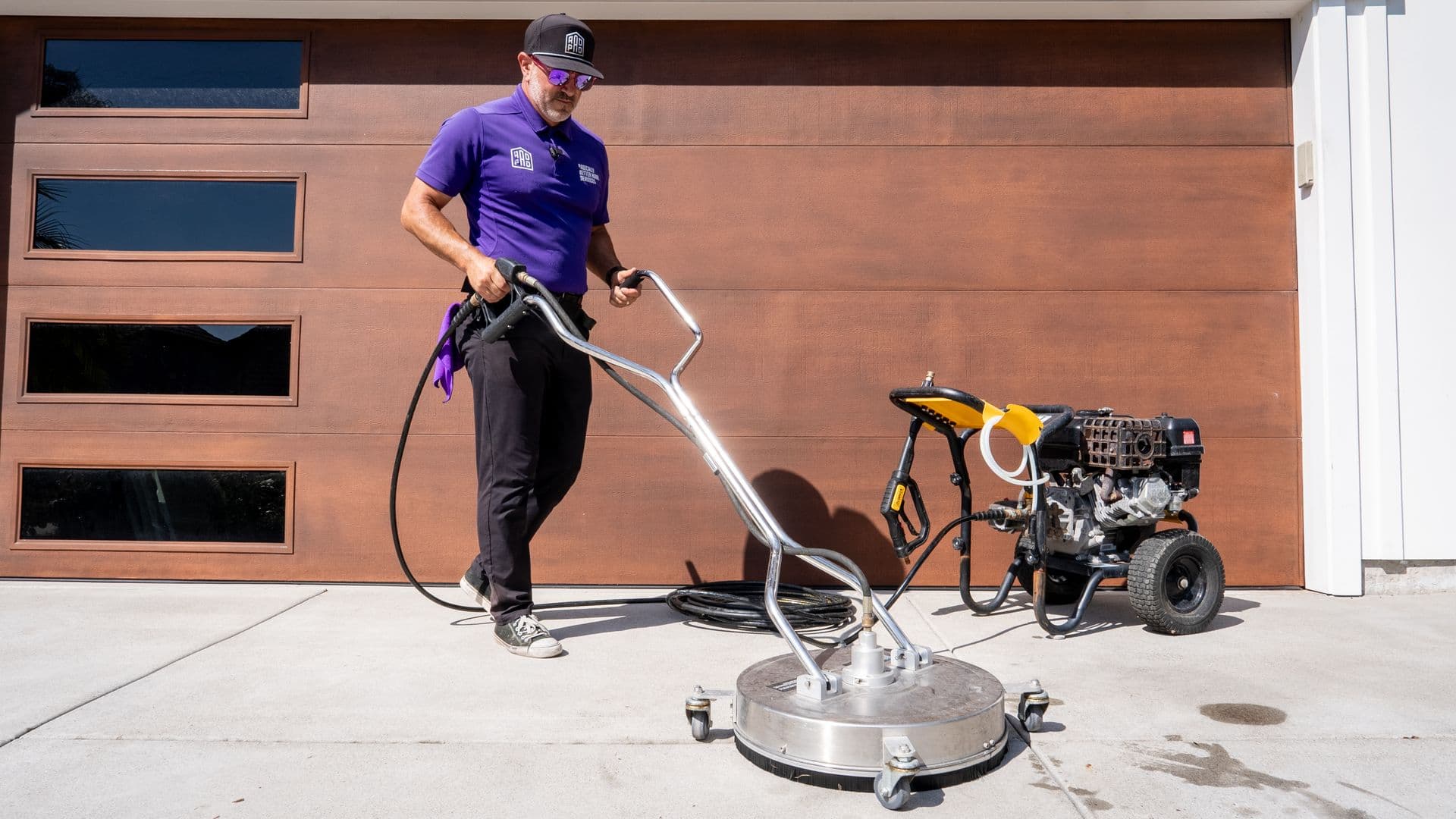
The method: A rotary surface cleaner instead of a pressure wand. A wand cleans in overlapping arcs and leaves stripes behind, while a rotary cleaner covers evenly for a uniform finish. On pavers and porous concrete, an optional seal afterward slows staining and keeps joint sand in place. Oil and rust are a separate problem: they can soak into porous material and need a deeper treatment, which is worth raising when you request a quote. The same surface cleaning service covers all of it.
Artificial turf
What wears it down: Fibers flatten with foot traffic, infill compacts, and organic debris works its way down where you can't see it, so turf starts to look matted rather than laid. In homes with dogs, the larger issue is bacteria. A single gram of pet waste contains an average of 23 million fecal coliform bacteria, according to the U.S. EPA, and that settles into the infill, not just onto the surface.
How often: Quarterly for households with dogs, and twice a year for turf that's mostly decorative. Pet corners and heavy-use areas often need attention between full visits.
The method: Power-brooming to lift the fibers and reset the infill, debris removed, and a treatment pass that deodorizes the surface and neutralizes bacteria instead of just rinsing it. If the infill has thinned or compacted, RadPad checks with the owner before adding any. Details are on Turf Cleaning & Disinfection.
Permanent and holiday lighting
What wears it down: Landscape and architectural fixtures drift out of aim, lenses film over, bulbs and connections fail, and near the water, salt dulls metal finishes. Holiday lighting has a different problem: it goes up and comes down on a deadline, usually from a ladder.
How often: A seasonal check-up keeps permanent lighting looking as designed: lenses cleaned, fixtures re-aimed, failed bulbs and connections repaired. Holiday lighting should be booked earlier than most people expect, since the good install dates go well before the season starts.
The method: One crew designs, installs, and maintains both. Holiday lighting is taken down on schedule and stored between seasons, so nobody in the house is on a ladder in December. Repairs and re-aiming cover systems someone else installed, too. See Permanent & Holiday Lighting.
A seasonal calendar for coastal homes
Most of these intervals line up with the seasons:
| Season | What to do |
|---|---|
| Fall (September to November) | Gutters before the first storm, the one visit not to skip. Second window cleaning of the year. Book holiday lighting early. Permanent lighting check-up. |
| Winter (December to February) | Much of the year's rain falls in these months, so watch that downspouts run during storms. Holiday lighting comes down and goes into storage. |
| Spring (March to May) | Gutters again once the rains are done. First window cleaning of the year. Solar before the dry season. Soft washing and surface cleaning. |
| Summer (June to August) | Turf, while the yard sees its heaviest use. Second solar cleaning late in the season, on twice-a-year schedules. |
| Every quarter | Windows within a mile or two of the coast. Turf in homes with dogs. |
How conditions change from one area to the next
The calendar is a starting point. Exposure changes over a few miles, sometimes over a few streets, so the right interval for one house can be wrong for the next:
- Bluff-top coast. Solana Beach homes take constant salt-laden air with no shelter, so glass films quickly and exterior metal ages fast. Shorter intervals do more there than heavier cleaning.
- Harbor and headland. In Dana Point, harbor-side and headland homes take constant salt air while homes behind the ridge get a fraction of it, so houses a few streets apart can need different schedules.
- Tile and stucco. San Clemente is Spanish-style almost throughout, and tile and stucco are exactly what pressure washing damages, so soft washing is the only correct method there.
- Eucalyptus and pine. In Rancho Santa Fe, the trees fill gutters continuously rather than seasonally and drop resin and debris on hardscape. A single annual visit rarely keeps up.
- Wind and dust. San Elijo Hills sits high enough that wind carries dust across the glass and into the gutters faster than in the valleys, and films the solar panels on its newer roofs.
- Solar on almost every roof. In Del Sur, nearly every roof carries solar, and inland dust and long dry stretches mean panels lose output well before anyone notices the bill.
Oceanside, Carlsbad, Encinitas, Del Mar, and La Jolla each have a page of their own, linked from the service areas index.
One schedule instead of seven
Seven surfaces can easily mean seven appointments with several companies. They don't have to: windows and solar suit the same visit, gutters and the second window cleaning both land in fall, and turf and quarterly glass fit the same calendar.
RadPad covers all of it, six categories and 18 services from glass to lighting, with one crew and one checklist per service, one schedule for the whole exterior, and one number to call. It's rated 5.0 across 86 Google reviews. If you're comparing companies first, how to choose an exterior cleaning company in San Diego covers what to look for. Or send a few details about the property, and RadPad will tell you what it sees and how often each surface actually needs attention, rather than selling you a schedule.
Written by
RadPad Home Service Pros
Locally owned exterior care across San Diego County and south Orange County: windows, solar, gutters, turf, surfaces and lighting, on one standard.
About RadPad